

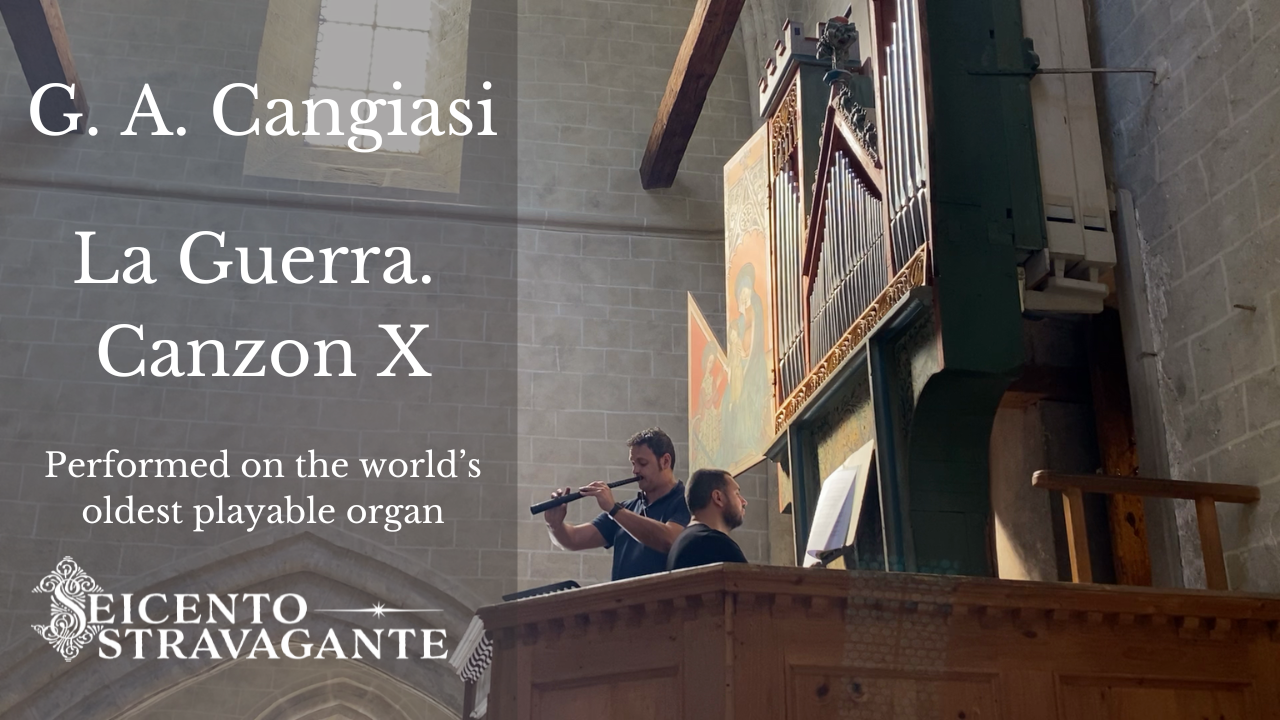
Giovanni Antonio Cangiasi (? – post. 1614) Canzon decima. La Guerra
from “Scherzi forastieri per suonare, a quattro voci” Milano, 1614
Seicento Stravagante:
David Brutti – cornett
Nicola Lamon – organ
Cornett by Paolo Fanciullacci (hz450)
Organ by anonymous 1435/37 (world’s oldest playable organ)
Live recording: Château de Valère – Sion (Switzerland), 10/08/2024
About the composer:
Giovanni Antonio Cangiasi (? – post. 1614)
Born in Milano, Cangiasi was a Franciscan friar. He was an organist at Vercelli cathedral from 1588 to 1590 at least, then, in 1602, at San Francesco in Milan. In 1607 and 1611 he was at the Franciscan abbey in Locarno. In 1614 he become organist at the Chiesa maggiore in Castelnuovo Scrivia. He died presumably in 1614 or shortly after.
About the organ:
The pipe organ of the Basilica of Valère was built in 1435; this date was confirmed by carbon-14 dating. A document in the church archive attests that between 1433 and 1437, the Fribourg painter Peter Maggenberg painted the organ doors.
The instrument remained unchanged until 1686 when, with a two-year restoration completed in 1688, the organ builder Christoph Aebi renewed the transmission system and created a new soundboard. Four new stops were also added during this restoration.
In 1718, an independent register was installed for the pedalboard. This register was likely installed during the 17th-century intervention but remained without its own registers until then, consisting of two united rows of bourdon, one of 16′ and one of 8′. A further restoration was carried out in 1827.
In 1954, the Zurich organ building company Kuhn Orgelbau restored the instrument, which had been silent for decades. While maintaining the additions and modifications of the 17th and 18th centuries, they brought the choir back to the original 448 Hz and the air pressure to 45 mm.
The organ is located above a swallow’s nest gallery against the wall of the basilica’s counter-façade.
The painted case is the original. It consists of a central triangular part flanked by two taller and narrower parts surmounted by a crenellation that makes them resemble the city walls. The painted doors are also the originals, the work of Peter Maggenberg. While the outside depicts the Annunciation, the inside depicts the Madonna and Child (on the left) and the Risen Christ with Mary Magdalene (on the right).
The organ is entirely mechanically transmitted (installed in 1686-1688) with a single 49-note keyboard with the first octave short and a straight short 9-note pedalboard constantly coupled to the manual.
The organ has a total of 9 stops, eight on the manual and one on the pedal. Of the eight manual stops, the Octav 2′, Quint Minor 1.1/3′ and Mixtur II stops are original from the 15th century.
About Seicento Stravagante:
Seicento Stravagante was created in 2018 by David Brutti on cornetto and Nicola Lamon on organ and harpsichord. The ensemble made debut in June 2018 in three concerts acclaimed by critics and public at the Basilica of San Vitale for the Ravenna Festival. Since then the ensemble regularly performs in the main organ and early music festivals such as Trento MusicAntica/Fondazione Feininger – Trento, Roma Festival Barocco 2023, Festival de l’Orgue de Valère – Sion, Accademia di Musica Antica di Milano, Festival Monteverdi – Cremona, Grandezze e Meraviglie – Modena, Festival Frescobaldi – Roma, Società Aquilana dei concerti “B. Barattelli”, Belgrade Early Music Festival – Serbia, La Voce e il Tempo – Genova, Spazio e Musica – Vicenza, Festival Organistico Internazionale di Treviso, Organi Storici in Cadore, Festival Oude Muziek Utrecht, Rassegna organistica “Gjgj Moret” – Venzone (UD) etc…
The discography of Seicento Stravagante includes: “Il Cornetto del Doge – Music in the Venice Renaissance”, Extended Place, 2021; “Maurizio Cazzati – Motets & Sonatas”, Pan Classics, 2022, with the baritone Mauro Borgioni; “Seicento Stravagante – Music for Cornetto & Organ”, BIS records, 2022.
Seicento Stravagante is also active in the promotion of the historical organ heritage: the two musicians regularly make audio and video recordings using the most prestigious Renaissance and Baroque authentic organs such as Dome of Valvasone – organ by Colombi ca.1532, Basilica Palatina di S. Barbara of Mantova – organ by Antegnati 1565 and church of St. Francis of Trevi – organ by Paolo Pietro da Montefalco 1509.In addition to their activities, they are joined by skilled musicians specializing in the Italian repertoire of the 17th century, like the baritone Mauro Borgioni, the baroque violinist Rossella Croce, the soprano Giulia Bolcato, the mezzosoprano Miriam Callegaro, whom the ensemble performs more complex programs and projects aimed at promoting the repertoire and virtuosity of the Italian courts between the 16th and 17th centuries.
#seicentostravagante #earlymusic #baroquemusic #classicalmusic
